Wednesday, April 25, 2007

What would it take to make Portland (Oregon) the Amsterdam of America?


That is, with relation to bicycles?

This is a question recently asked by the Portland Office of Transportation, as a part of their update to the citywide Bicycle Master Plan.

What would it take for Portland to become the Amsterdam of America?

(Aside from the obvious: removing all of those pesky hills...?)

1) User fees for cars:
- Introduction of European-style gas taxes that raise the cost per gallon of gasoline to above $5.
- Congestion pricing in congested areas, following Ken Livingstone's London example, that allows bicycles free entrance but charges cars.

2) Creation of expanded bicycle and pedestrian infrastructure. In areas of high congestion, remove the least-efficient use: automobiles. Use the additional space to provide facilities dedicated to bicycles, so they can zip by pedestrians and streetcars on their own paths.
- In Downtown Portland, for instance, this might mean taking a lane of 3-lane one-way streets and making it into a Class 1 bicycle facility. This bikeway would fit between the existing sidewalk and the parking lane.
- In neighborhood commercial districts, when over-crowding causes congestion, automobile traffic needs to be the first thing to go, and bicycle facilities should be the first thing installed to take its place.
- In the neighborhoods, this would mean the creation of bicycle routes where bikes can travel as far as possible, unhindered by vehicles. All stop signs on bicycle boulevards should be replaced by traffic circles. Stop lights should act like the one at 39th & SE Clinton, permitting bikes but stopping cars.
- Bicycle "freeways" like the Springwater Corridor should be built in as many places as possible: Sullivan's Gulch, the North Portland Waterfront, along the SE Portland RR ROW that extends from the river to Crystal Springs Gardens/Golf Course, etc.

3) Bicycle rental facilities should be widely dispersed throughout the city that provide bikes for little or no charge for those who need to use them for a quick trip.

4) Bicycle parking should be provided in mass quantities at popular destinations. There are already complaints about a shortage of bicycle parking opportunities in downtown Portland. This needs to be resolved ASAP, and bicycle parking lots need to be fitted into the infrastructure where demand requires them. Outside of the Amsterdam rail station, for instance, is a sea of hundreds of bikes, all locked up right next to one another. I've also seen stacked bicycle parking. Whatever it takes to fit the bikes into the real estate available.

5) Commuter rail systems need to bring people into the central city from neighboring cities, and provide plenty of room for secure bicycle parking at their stations, as well as plenty of room on board for bicycle hooks. Part of bicycle mobility is the ability to extend the range of your bicycle by hopping on a fast, efficient train to get to places slightly further afoot.

6) Development density within the city needs to increase, so that more people are living closer to more destinations, making the bicycle just inherently a more sensible option for making more trips.

7) Automobile parking needs to be regulated to make it just a little less easy to park everywhere for free. Charging for parking in most commercial districts would be a good start. Taxing every surface parking space would be another good start -- say, $5 per space per month? This would make people and businesses seriously consider exactly how many car parking spaces they really need and are willing to pay for.

8) The police need to encourage bicycling, not stifle it. Enforcement of traffic laws against bicyclists who are not causing injury to others should be the absolute lowest enforcement priority for the police force. In general, unless a bicyclist has caused an accident, there is no need to write them a ticket. Period.

9) Oregon should adopt an Idaho-styled Bicycle Code that allows bicycles to treat stops signs as yield signs and stop lights as stop signs.

10) Bicycling needs to be respected, encouraged and embraced.
- Elected officials and city employees should ride bicycles whenever possible.
- Perhaps a mandate for a certain percentage of city employees to ride their bikes to work, ala Mexico City, might be one good measure to consider.
- In all cases, encouraging bicycles should be the rule rather than the exception.

Thursday, April 19, 2007

The VideoVets Project


Check out this project. It's just a series of interviews with troops who have served in Iraq, and their families.

http://pol.moveon.org/videovets/index.html

You can rate each of the videos according to how much you like them.

The winning video will be produced by Oliver Stone.

Or, you can just watch them.

It's up to you.

But I found it pretty powerful. I don't often talk to troops or their families, so it's a perspective that was somewhat new to me.

cheers,
~Garlynn

Thursday, April 05, 2007

Video Ads on Subways -- and Art


According to a recent news article, ads are now springing up in subway tunnels between the stations. These "video ads" act like cartoon flip-books: A series of images is lit up by individual spotlights if a train passes by at 25mph or faster. The moving train allows the images to be displayed at 24+ frames per second, which is enough to give the illusion of a movie, more or less. Or, at least, it looks cool.

BART is now doing "video" ads in its subway tunnels between stations in San Francisco, and I recently had the opportunity to view the first batch. Pretty interesting stuff, and better than a blank tunnel wall.

According to the article referenced above, however, a new generation of ads will soon be installed that uses LED screens so that the ads can be changed more rapidly & easily -- and controlled remotely.

What I propose is a "Percent for Art" policy, to be implemented when the LED screens are installed. Basically, a certain percentage of the content being cycled on the LED screens would be non-commercial, and produced by local artists on commission to the transit agency. The article states that these ads bring in revenue upwards of $50k a month. Surely, that would allow enough padding for an artist to receive a small commission of, say, $2,000 to produce a quick piece of video art that could be displayed in between the ads on such a system.

I would propose that the art be randomly interspersed with the ads, varying between a rate of 1/3 art, 2/3 ads and 2/3 art, 1/3 ads, depending on, perhaps, time of day.

This would be a great way to expose transit passengers to art, while also building ad revenue to offset the costs of operations for transit agencies -- not to mention supporting the local art community.

BART has a lot of miles of tunnels where this could be installed, as does San Francisco's MUNI.

In addition, Tri-Met's Westside Light Rail tunnel in Portland, OR offers a couple of miles worth of unspoiled tunnel real estate where such an installation could be an instant hit. I'm particularly fond of this idea, because it is the only significant tunnel on Tri-Met's system, and would offer a premier showcase for both ads and art to Portland-area commuters. Plus, Tri-Met already has a Percent for Art program, so the concept of building this into a new advertising contract should not be new to them.

This is an exciting new 21st-century technology and medium for communications. Let's not waste it all entirely on just commercial content.

Let's make sure there's a percentage for art.

cheers,
~Garlynn

Tuesday, April 03, 2007

A Game Plan For Our Species (and thus, our planet)


Advance warning: This post deals is a bit more metaphysical than most, and ventures a bit into quantum theory. It's also a bit lengthy, but worth the read, IMHO. You've been warned.

+ + + + + +

So, I've been thinking a bit about life. I would say lately, except that this has been a favorite topic of mine to ponder since before I was ten years of age. But I digress. I've come to the conclusion that, if there is any cosmic purpose to any of our individual lives, or even for us collectively as a species, it is this:

Purpose of species: Procreate, reproduce, evolve and generally self-replicate

One could argue that, as it says somewhere in the Bible, the whole purpose of our species is really just to be a good shepherd to the flock of other non-human living things on this planet.

Well, shepherds tend to lead their flocks to different places from time to time, so that fact doesn't necessarily derail my train of thought much by itself. Let's continue with this thought experiment and see where it leads, shall we?

If we were all to follow this cosmic guidance and just pro-create to our hearts content, we might eventually find ourselves with a planet that is rather full of human beings. What's this? We're already in that situation? Oh dear. Well, that brings us to our first limit, then:

Limit: One planet, already overpopulated


So, if our planet is already just teeming with human life, which represents mouths to be fed, brains to be kept entertained, and arses to be driven around in big gleaming automobiles requiring some sort of fuel for propulsion... well, that's an awful lot of resources that this population is demanding to support their day-to-day life. At some point, this combination of population plus required resources is going to run up against the reality of a finite amount of available resources on this one planet. And, because we've all collectively made the startlingly good decision to keep the generally high quality of our lives high (we have, after all, made that decision, haven't we?), we probably don't want to go about ruining our quality of life by mucking up our own planet so badly that it's no longer pleasant to live here. That brings us to our second limit:

Limit: Must not destroy home planet

Stephen Hawking has said that we should colonize space, basically as an insurance policy for the survival of our species, given all the generally bad things (war, disease, nuclear power & weapons, FOX News, etc.) that happen on Earth. I wouldn't quite put it that way. Rather, I think it is our destiny to colonize space. It's part of "go forth and multiply." Once we've begun to near the limits for human habitation of this planet (and I believe that we are reaching that point, or will within a couple more centuries anyways, if we manage somehow to make it that far as a species), it just seems rather logical to make that next leap and go out into space. It's like when you go out to a really crowded dance club, you meet some really attractive member of the opposite sex (remember: procreation), and you both decide collectively to bounce out to someplace a little more quiet. There really isn't enough countryside for the entire species to just go off and get some quiet place in the countryside to live out the rest of our existence, and besides, the existing residents of the countryside (especially those of the non-human persuasion, such as the animals) might object.

That leaves us, collectively, with our first solution, involving the colonization of places that are not on Earth where we might be able to have a little bit of peace and quiet:

Solution: colonize outer space.

I'm talking long-term here. Not next week, obviously, and not just because I've already got other plans for next week. No, I mean, this is a really long-term goal, kind of like JFK saying that we needed to land a man on the moon... he said that in, what, 1961? It took us the rest of the decade to do it. This would probably take a bit longer.

However, we don't want the effort to colonize outer space to itself become the death knell for the rest of us back here on Planet Earth. If we were to use, say, the Space Shuttle -- or indeed, any solid- or chemical- based rocket program -- as the vehicle necessary to establish such a large presence in space, that would not be a very good thing for our environment. The carbon dioxide emissions (hello, greenhouse gasses!), other pollution, fuel consumption -- it all just sort of would start to add up, now wouldn't it? That brings us to our third limit:

Limit: To colonize other planets would seem to require many trips into space, each of which creates an awful lot of carbon dioxide & other greenhouse gases & pollutants, thus contributing to global warming and said destruction of home planet

So, we've got to figure out some way to get our species (collective arses) off the planet without creating a whole lot of pollution, greenhouse gasses, etc. There have been a number of proposals over the years as to how we might accomplish this, but recent momentum seems to have been in the direction of this: Put passengers and cargo into a capsule. Attach the capsule to a cable. One end of the cable is attached to the earth. The other is attached to an anchor object outside of the reach of Earth's gravity. The capsule pulls itself up the cable, and voila! Its' contents are in orbit. This brings us to our second solution:

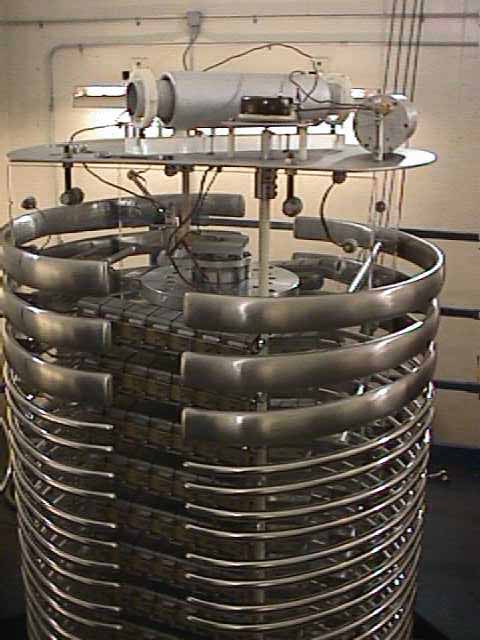
Possible solution: A space elevator


Of course, you're probably thinking to yourself about now, "Well, that sounds like a pretty stupid idea. Wouldn't the damn thing just fall out of the sky after a while?"

Yes, that would seem to be the case, which brings us to another limit:

Limit: What does the space elevator anchor to in space?

Well, the space elevator would need to anchor to something far enough up in space that it is sufficiently free of the earth's gravity to say up there for a while. It's got to be something with a lot of mass -- like a space station, perhaps -- to hold up the cables. However, after a while, even if the object were quite massive, and located some distance from Earth, it would seem that the fact of the cables themselves might eventually act to start tugging it back towards Earth. This brings us to another limit:

Limit: The cable would probably tug this object back into orbit eventually, and thus back onto the planet. Big collision, large impact, not good news for the space program or previously-stated goal of colonizing other planets.

Of course, there's a pretty obvious solution here: Why not just fire some thrusters every once in a while to provide a course correction to the space station so that it remains in orbit, and doesn't slowly plunge back in the general direction of Earth's gravity well?

Potential solution: Fire thrusters to provide course corrections often enough to keep the anchor object (space station) up in space and not plummeting towards the ground.

Thrusters, however, would seem to require a fuel supply. Fuel, as you may have noticed in the news lately, seems to be running a bit short on the good ole' planet these days. So, even assuming we could just toss a few drums of fuel onto the space elevator and pop them up to the space station frequently enough to keep it in orbit and out of the atmosphere, this wouldn't seem to represent the most sustainable possible solution, now would it? This would seem to represent another limit:

Limit: Fuel must be used to power the thrusters, fuel might be in short supply in orbit, it sure seems to be in short supply down here.

But what if the fuel didn't need to be brought up from earth? After all, this space station could probably erect a rather vast solar panel array, given the vastness of space, the general lack of gravity, etc. And, according to Einstein, it is possible to convert power into mass (E=mc^2), and indeed, this has already been done by scientists with particle accelerators. So, the space station could collect solar power, and using a particle accelerator, convert this energy into the thrust necessary to keep the space station in orbit. Sounds like a solution to me:

Possible solution: Use solar power. Convert power into mass (E=mc^2) using a particle accelerator, and use this as the thrust to keep the space station in orbit.


Great, so now we're in orbit. Now what?

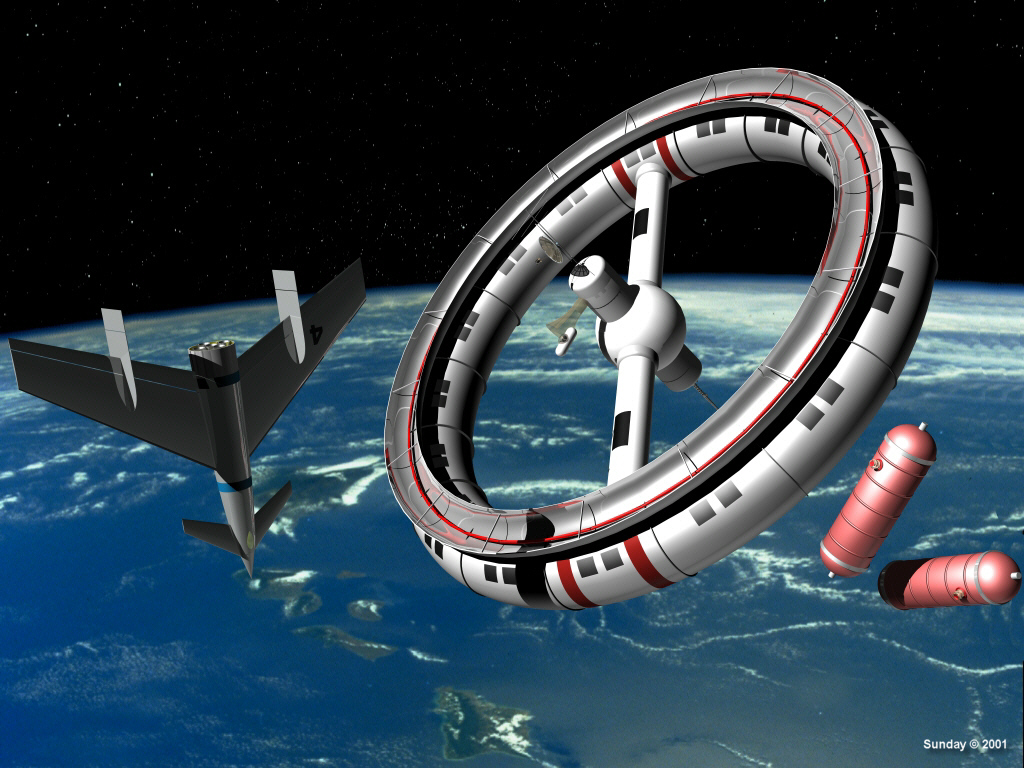
Space travel. We could build giant colony-ships in orbit, using materials both brought up from Earth on the space elevator, and mined on the Moon (I hear it's rich in Titanium. That's a good thing, because titanium not only makes great bicycles, it also makes great airplanes and spacecraft). These colony-ships would create their own gravity (likely by rotating), grow their own food, recycle their own water -- and be large enough to combat the problems of a closed environment that were encountered in the Biosphere 2 project in Arizona. In a sense, they would have to be be colonies unto themselves, capable of sustaining not only their initial human population, but also any increases in that population (and its supporting animal companions) due to aforementioned reproduction.


These colony-ships would also have to travel through space a very long distance to reach other planets outside of our solar system, and to do so, they would have to get moving very fast. How fast? Between 0.99 and 0.999% of the speed of light (speed of light = c) would be ideal, or even faster. You see, no object can travel faster than the speed of light. But, objects can, in theory, be made to travel very close to the speed of light. If we wanted to visit the nearest star system, Alpha Centauri, which is four light years (a light year is the distance that light can travel during one year) from Earth, it would take us a bit more than four years travelling at 0.99c (could be closer to five, what with acceleration, deceleration and all). However, that's the time that us folks back on Earth would perceive it as taking. For the folks on the ship, it would seem to be a lot quicker of a journey. At 0.99c, there would be a "time dilation factor" of seven, so the astronauts would only experience seven months if they could make the whole journey at speed. At 0.999c, the time dilation factor would be twenty, and if the trip were made entirely at speed, it would only take about a month.

Of course, the trips would take longer, because who knows how long it might take to accelerate up to the speed of light, then decelerate back down from it?

Also, just because Alpha Centauri is the closest star, doesn't mean that we really have any reason to go there. We might need to hike quite a longer distance through space to reach a suitable star system where we might be able to construct a colony. Some have argued that we should try colonizing the Moon and Mars first, to get a taste for the necessary technology. I've got no objection to that, but why stop there?

After all, this is the species that gave Jimi Hendrix and the Beatles to the universe. I think we're worth saving and replicating elsewhere, don't you?

Wednesday, March 28, 2007

Smarter Suburbs


According to a recent Daily Journal of Commerce article, in Oregon some Legislative leaders are talking about a Congestion Relief package to tie the state over from now through 2009, when they expect to be able to offer a more comprehensive transportation solutions package. It's good to see that some folks are thinking big-picture, but "congestion relief" doesn't sound like the sort of terminology that describes Smart Growth, TOD, bicycle lanes and better transit.

There's an interesting article in the February 2007 issue of _Urban Land_, called "Looking Back to Plan the Future." OK, it's actually not that interesting of an article, except for the come-on quote at the beginning:

"Casting aside the failed experiment of suburbia in the United States, planners are looking back to age-old principles for guidance in planning a future with modern challenges."


It was written by a planner from.... Dallas, Texas.

And it got me to thinking: A lot of what needs to be happening in the next, say, 20 years is a re-building of our suburban areas. We do need smarter suburbs. We need to make it easier for people to walk or ride their bikes for local trips in their neighborhood, as well as to get to the local transit stop. Even if we can't get street connectivity in most places in the suburbs for *cars*, we should be thinking more about retrofitting suburbs to provide through-connectivity for pedestrians and bicyclists. Even if this means using a little bit of eminent domain here or there, it would be worthwhile if the end product were a really good suburban grid of bicycle/pedestrian paths that connected every street in every neighborhood with every neighborhood center and important destination, just like you would get in, say, Portland's eastside with its regular street grid. Except that the grid would mainly apply to bike/ped, and cars would be stuck with the 1950s-style suburban street system that already exists.

The difference would be that there would, in theory, be fewer cars and more bicycles & pedestrians on the suburban bike/ped network.

The image at the top of this post depicts a path built between two houses allowing students to walk or bicycle to a local school from their cul-de-sac.

Update, 2:30pm March 28th:

Over at Portland Transport, another commenter asked:

"some people like living on isolated, car friendly, suburban, dead-end streets.

"Actually, I am going to guess most people like that kind of living. Why change it?"


This is a very good question, and I'm glad that you asked. Even though the quote calls suburbia in general a "failure," I think there are a lot of people who rather like it.

My great-aunt, for example. Lives on a cul-de-sac out in Hillsboro.

But you know what? At the end of the cul-de-sac is the entrance to a bike/ped path. This path connects with other paths. They lead all throughout her subdivision, and connect her with other, important destinations like... the community swimming pool, and other cul-de-sacs. Oh, and her niece, who lives on another cul-de-sac that would be about 8 blocks away driving, but is only about 300 feet on the path.

What I'm talking about is to expand this type of path system, which is often found within many suburban developments, such that the paths connect up with one another to form an actual, use-able ped/bike path "grid" that not only connects within each neighborhood, but connects to other important destinations such as the neighborhood commercial center and transit stop.

Would this decrease how much people liked living on their quiet, dead-end streets?

No.

Would it make them any less quiet or dead-endy?

No, unless you happen to be riding a bicycle (pretty quiet, all things considered) or walking (also a rather quiet activity).

But, could you then ride your bike or walk from your quiet, dead-end street to the local transit stop, video store (ooh, how 20th century), grocery store or pub?

Yes.

Without needing to drive your car.

Your nice car can then sit in its nice garage and save its nice $3.50/gallon gas for a more important trip.

Does this represent a fundamental change to "that kind of living"? I don't think so. Just a minor enhancement, maybe the addition of something that should have been there all along, that's all.

Monday, March 19, 2007

Congestion Pricing in Portland, OR


Recently, there was a post on PortlandTransport on why Congestion Pricing isn't more widely implemented. This was based on a blog post written by Michael Manville (of UCLA) on the same topic. What follows are the thoughts that I had after reading Professor Manville's article, basically related to how Congestion Pricing might work in the Portland region.

I think that the issue of Congestion Pricing has thus far been implemented in two very different ways, which should perhaps be considered differently:

1) Cordon-style district congestion pricing, ala London and Stockholm
2) Peak period variable tolling of specific lanes on a freeway -- so-called High Occupancy Toll (HOT) Lanes.

The first could potentially be implemented in Portland for an area encompassing the 1990s-era Fareless Square district (before this district was expanded across the river to include Lloyd Center). This district generally has the most surface street daytime traffic congestion in the city. The revenue could be used to help improve transit service for the district, by paying for some capital costs for new streetcars/LRVs, as well as the additional operational costs associated with these vehicles. More bicycle facilities could also be constructed leading into and within the district. Presumably, this would encourage many folks to stop driving and start taking transit or riding their bicycles to enter the district.

The second idea could be implemented on Portland's freeway system, and indeed, this does make some sense when taken in tandem with the idea of removing I-5 from the east bank of the Willamette. I-405, I-26 through the tunnels, I-84 through Sullivan's Gulch and I-5 through NoPo and the Terwilliger Curves could all have congestion pricing applied to them. This charge could help pay for the capital costs associated with the removal of I-5, and perhaps then with the capping of the freeways and the building of parks, bike lanes and neighborhood centers on top of them. Call it a citywide freeway mitigation program.

What the program needs, apparently, is a strong advocate to make it happen.

Commissioner Sam Adams... are you listening?

cheers,
~Garlynn

Tuesday, February 27, 2007

Mercedes announces new 42mpg 170hp Bluetec. But where is the Bluetec Hybrid?


According to the Wired autopia blog, Mercedes has just announced a Vision C 220 Bluetec. "Mercedes says its 125 kW / 170 hp engine manages to get a hundred km (not miles, so don't get too excited) out of 5.5 litres of diesel. "

To answer the question that every American reader will have about this announcement, here's the answer:

According to the figures above, the Vision C 220 Bluetec will get 18.2 kilometers per liter, which is about 42.8 miles per gallon, out of its 170hp 4-cylinder diesel engine.

That's great. So, why not make it a plug-in hybrid? The thing would f*cking smoke if it had a decent electric engine running in parallel with that diesel!! We're talking... probably around 80 mpg, perhaps, just by going to hybrid, maybe more like 120 if there's a lot of city driving using plugged-in battery power?

So, riddle me this, Dr. Z: Why hasn't MBZ created a hybrid vehicle, much less a plug-in hybrid vehicle?

When might we expect the first plug-in Bluetec hybrid?

Longtime readers of this blog will know that I have been advocating for a plug-in diesel hybrid for some time. Perhaps Mercedes will be able to use this Bluetec technology to ultimately build such a vehicle?

Or, maybe it will be Toyota that finally produces the first such vehicle? They have reportedly already produced a diesel-hybrid truck, but it cost $10,000 more than its non-hybrid counterpart.

But for good ole' MBZ, where a car costs $41,000 anyways, what's another $10k between friends? If a diesel-hybrid vehicle could be produced that came with a 10-year, 500,000-mile warranty to justify the extra expense, and a financing plan to boot, I bet people would buy it.

After all, according to the above article,
"A study by the Massachusetts Institute of Technology's Laboratory for Energy and the Environment found that even with aggressive research, fuel-cell cars won't beat diesel hybrids on total energy use or greenhouse gas emissions by 2020."
So, somebody will make a diesel-electric hybrid. Maybe a lot of somebodies. Volkswagen is also working on it:

Volkswagen will enter an experimental diesel hybrid car at the Michelin Challenge Bibendum in Shanghai next month, a contest for alternative powertrain vehicles.

"The technology is there and has been well known for years. The problem with hybrid is the battery technology," a VW spokesman said, noting no one yet has come up with a hybrid battery that lasts as long as the car it powers.
So, if battery technology really is the sticking point right now, then perhaps we will see progress soon. Toyota has already announced plans to switch to Lithion-Ion batteries for its third-generation hybrid vehicles, due out in 2008 or 2009, a move that they expect will bring the cost of hybrid vehicles down to the level of other vehicles, while extending battery life and increasing efficiency.

The potential of diesel-hybrid technology is huge. University of San Diego engineering professor Jim Burns has reportedly developed a $60,000 diesel-hybrid sports car that gets 80 mpg and does 0-60mph in 4.3 neck-jerking seconds. He says that if he gets 10,000 orders, he'll mass-produce the vehicle.

Finally, according to the WSJ, a French consortium, using batteries from Wisconsin, will be producing an electric van for the French postal fleet, and hope to have a plug-in diesel hybrid version of the van for sale to the public by 2010.

Thursday, February 15, 2007

For Bicycles: Stop Signs = Yield, and Traffic Lights = Stop Signs!!


Let's expand Idaho's bicycle code nationwide! Or at least to Oregon. And then California. And see what happens next.

The law intends to ease passage of bicyclists through controlled intersections (those with lights or stop signs) when cross traffic is not an issue.


Here's what it says:

http://www3.state.id.us/cgi-bin/newidst?sctid=490070020.K

49-720. STOPPING -- TURN AND STOP SIGNALS. (1) A person operating a
bicycle or human-powered vehicle approaching a stop sign shall slow down and,
if required for safety, stop before entering the intersection. After slowing
to a reasonable speed or stopping, the person shall yield the right-of-way to
any vehicle in the intersection or approaching on another highway so closely
as to constitute an immediate hazard during the time the person is moving
across or within the intersection or junction of highways, except that a
person after slowing to a reasonable speed and yielding the right-of-way if
required, may cautiously make a turn or proceed through the intersection
without stopping.
(2) A person operating a bicycle or human-powered vehicle approaching a
steady red traffic control light shall stop before entering the intersection
and shall yield to all other traffic. Once the person has yielded, he may
proceed through the steady red light with caution. Provided however, that a
person after slowing to a reasonable speed and yielding the right-of-way if
required, may cautiously make a right-hand turn. A left-hand turn onto a
one-way highway may be made on a red light after stopping and yielding to
other traffic.

Basically, it says that bicyclists can roll through stop signs, and proceed through red lights after coming to a full stop, if doing so is safe and doesn't cause a conflict with vehicles who already have established a legal ROW path through the intersection.

Why not? Just codifies into law what is already standard practice for many cyclists in major cities anyway. If connected with a simple public safety outreach campaign to publicize the new law, it could be revolutionary for bicyclists. I would also suggest that the following sign be gradually phased in at intersections, especially in conjunction with already-existing stop signs. It would ideally be posted below the stop sign, and would be smaller. It would mean two things:

1) Stop signs equal yield signs for bicycles.
2) Vehicles should yield to bicycles.

This should help to clarify the situation to everybody involved:


Update (Feb. 15th, 2007):

There's a lively discussion concerning this very topic on bikeportland, featuring both pro and con arguments related to changing the law so that bicyclists could treat stop signs as yields signs and traffic lights as stop signs (if, at the discretion of the bicyclist, this was a safe thing to do given conditions). It's interesting to point out that the con argument winds up supporting the law change, but wanting it to be accompanied by increased penalties for failing to yield and for outright blowing a light -- while the pro article just wants the law changed. You'll have to read the articles to see what I mean.

Also, a research paper from UC Berkeley makes a very compelling case, based on physics, for changing the way that bicycles relate to stop signs (either removing some stop signs along bike routes, or allowing bicycles to treat them as yield signs).

Wednesday, February 14, 2007

Victory in Anbar Province? Vision for Iraq?


Check out this powerpoint presentation. And pass it on:


This post gives some detail and background on the soldier who created the presentation:

It's simple genius at its best. And it's too bad that he got killed by a roadside bomb, though that event may have provided the publicity that has made this thing available for us to view.

Enjoy.

cheers,
~Garlynn

Monday, February 12, 2007

Open letter to Speaker Pelosi, encouraging immediate impeachment of President Bush

Dear Speaker Pelosi,

I believe that the impeachment process needs to regain the credibility that it lost under Republican rule, and that President Bush is the ideal poster child for this effort. His initiatives, policies, proposals and history are not only in every way at odds with what I consider to be accepted morality, but they do a dis-service to America and at worst expose him as a traitor to his own country. His criminality needs to be punished.

He and his administrative team, including the vice-president, must be removed from office in an orderly, timely and responsible manner that restores the confidence of this country in the constitutional rule of law and specifically the process of impeachment.

This message must be responsibly sent as soon as possible to restore the respect of the rest of the world for the rule of democracy in this country.

Yours truly,
Mr. Garlynn G. Woodsong, Esq.