Thursday, April 16, 2009

Global Drug Policy Must Change Now


We need to have a national -- and a global -- conversation about drugs. Let's start with the big picture.

It is clear that the world is currently undergoing a massive paradigm shift, away from the 20th-century and into the 21st. The specifics of this paradigm shift are not entirely clear yet (historians will be able to make better sense of it after it has occurred), but it is clear that the global financial system meltdown has spurred the housing market to shift from suburban sprawl towards more focused development in cities; for cars to shift from gas-guzzling SUVs to plug-in electric hybrids and similar more-efficient vehicles; for the American presidency to shift from a war-mongering rich white idiot towards a smart guy who actually understands the issues and has a clear progressive vision for the future. This paradigm shift, however, is not all roses and honey. There is massive bloodshed and economic hardship worldwide. What I would like to propose is a way to ease just a little bit of both, both abroad and domestically, through the following program:

* Legalize all drugs, worldwide
* Tax their productions and distribution
* Regulate them like alcohol and cigarettes are currently regulated
* Use some of the tax proceeds to help fund treatment programs and other initiatives to deal with the societal consequences of this program.

Currently, the United States is spending billions of dollars in places like the Andes of South America, Central America, Mexico and Afghanistan to fight drug production and battle with drug cartels and the terrorist/guerrilla/insurgent groups that are funded by their money. Instead of spending American taxpayer dollars on military spending for a war on drugs that cannot ever be won, we should cut out the financial legs of the international drug cartels by shifting drug profits to the sovereign nations within which drug production occurs, which will both empower and stabilize those governments while at the same time ridding them of some of their largest domestic problems.

In Afghanistan, the Taliban is largely funded by domestic drug production and international trafficking. Despite American and NATO efforts at drug eradication, hashish production is rising even as the military reports signs of progress in opium poppy eradication.

In Mexico, over 10,475 executions related to the drug war have occurred since President Calderon took office in 2006. This is just the latest Latin American country where drug violence has raised its ugly head, as thousands have died in Colombia, Peru, Bolivia, Panama and elsewhere in the decades since the United States has been fighting the drug war with all the force of its military might. There are signs, however, that this hemisphere is getting fed up with this failed policy, and that change may be on the horizon.

Latin American leaders, in releasing a report in February calling for a global paradigm shift in drug policy, said:
“Prohibitionist policies based on the eradication of production and on the disruption of drug flows as well as on the criminalization of consumption have not yielded the expected results. We are farther than ever from the announced goal of eradicating drugs.”

We will never eradicate drugs. We've tried for decades, indeed for nearly a century, and all the best efforts of the best minds and most powerful governments in the world have failed. Americans and others around the world continue to use drugs of all flavors, and the market continues to supply them. The time has come for a fundamental change in the system.

A recent essay in The Wall Street Journal strongly advocates for the legalization of drugs, saying:
Decriminalizing the possession and use of marijuana would raise billions in taxes and eliminate much of the profits that fuel bloodshed and violence in Mexico. ... The only long-term solution to the cartel-related murders in Mexico is to legalize the other illegal drugs we overlooked when we repealed Prohibition in 1933.

Obviously, the recent media storm regarding all of the drug-related deaths in Mexico is weighing heavily on the minds of many people in this country. But, the WSJ article goes further:
We cannot destroy the appetite for psychotropic drugs. Both animals and humans have an innate desire for the altered consciousness obtainable through drugs. What we can and should do is eliminate the black market for the drugs by regulating and taxing them as we do our two most harmful recreational drugs, tobacco and alcohol. ... Marijuana presents the strongest case for this approach. According to some estimates, marijuana comprises about 70% of the illegal product distributed by the Mexican cartels. Marijuana will grow anywhere. If the threat of criminal prosecution and forfeitures did not deter American marijuana farmers, America's entire supply of that drug would be home-grown. If we taxed the marijuana agribusiness at rates similar to that for tobacco and alcohol, we would raise about $10 billion in taxes per year and would save another $10 billion we now spend on law enforcement and imprisoning marijuana users and distributors. ... After we reap the rewards from decriminalizing marijuana, we should move on to hard drugs. This will encounter strong resistance. Marijuana is a relatively safe drug. No one has ever died from a marijuana overdose nor has anyone gone on a violent rampage as a result of a marijuana high. Cocaine, heroin and amphetamines, on the other hand, can be highly addictive and harmful, both physically and psychologically. But prohibition makes those dangers worse, unleashing on vulnerable users chemicals of unknown content and potency, and deterring addicts from seeking help with their dependency. There is burgeoning recognition, in the U.S. and elsewhere, that the health benefits and the myriad social and economic advantages of substituting regulation of hard drugs for their prohibition deserves serious consideration.

We must recognize that our global war on drugs has failed. We must recognize that our domestic war on drugs has failed. We must move immediately to legalize drugs, both internationally and domestically. This will not only allow us to achieve many elusive foreign policy goals that have been impossible up to now (such as finally defeating the Taliban and other drug-funded insurgency groups), but it will allow us to honestly deal with the myriad domestic issues created by our failed drug policies. This will require our national conversation to address some very tough topics, but luckily we are not without examples from abroad to help guide us as we make the difficult decisions and craft the policies that will be required to govern our changed society. The WSJ article gives us one lead:
A most impressive experiment has been underway in Portugal since 2001, when that country decriminalized the possession and personal use of all psychotropic drugs. According to a study just published by the Cato Institute, "judged by virtually every metric," the Portuguese decriminalization "has been a resounding success." Contrary to the prognostications of prohibitionists, the numbers of Portuguese drug users has not increased since decriminalization. Indeed, the percentage of the population who has ever used these drugs is lower in Portugal than virtually anywhere else in the European Union and is far below the percentage of users in the U.S.. One explanation for this startling fact is that decriminalization has both freed up funds for drug treatment and, by lifting the threat of criminal charges, encouraged drug abusers to seek that treatment.

There is thus an emerging national and international consensus that the war on drugs has failed, and that continuing to spend money fighting it is to throw more good money after bad. We can achieve many foreign policy goals, while also paving the way for a new golden era of enlightened domestic policy, by legalizing, taxing and regulating all drugs. This effort must be undertaken both within the United States and internationally, and it will involve renegotiating the many treaties that we have forced on our foreign allies over the years. This effort will be worth it, and it will pay off by providing for peace and prosperity in a way that nearly nothing else will that we could do as a nation right now. We must not let the difficulty of the effort deter us from this goal, as it is indeed the only reasonable option that we have left.

To a brighter future!

cheers,
~Garlynn

Wednesday, April 08, 2009

BART, Translink and MTC


***

Updated as of August 3rd, 2009: BART has apparently turned on Translink for revenue service! Congratulations are in order, all around. Also, I want to make clear that I am no longer an employee of the Metropolitan Transportation Commission, and write this in my capacity as a private citizen.

***

So, as of March 23, 2009, BART has announced that it will deploy the regional Translink card on its system beginning in early June, 2009. This is after a top BART official suggested in 2008 that the Bay Area dump the contractor running the project, and basically walk away from it. Though, if you attempt to go to the BART website now to confirm that date, you've met with a much-more-vague "this summer" as the predicted timeframe for the rollout.

Either way, I'll believe it when I see it.

Why?

The Metropolitan Transportation Commission (MTC, my employer for eight-plus years), has been working on the idea of a regional electronic fare card, one that would allow for seamless travel amongst all 22+ Bay Area transit operators, since at least the early 1990s. Since then, over $88 million (out of an estimated $100 million total project cost)* has been spent, and yet the card is not even available for use on the Bay Area's flagship regional transit operator, BART.

However, right after I first started at MTC, in 2001, I was a part of the Translink pilot program, and used the electronic fare card for my daily commute on BART for over six months. It worked fine then (and it works fine now). Indeed, BART could have (and was originally scheduled to) turn Translink on for full service in 2002; however, for political and bureaucratic reasons, they never did.

Let's take a quick look at some of those reasons.

First, there's the money that BART receives from expired magnetic tickets. When you take your BART ticket out of the faregate at the end of your trip, and there's not enough value left on it for another full BART journey, but there is still a greater-than-zero value -- and you choose to buy a new ticket rather than to recharge this ticket -- BART gets to keep the change. This has been identified as a source of tens of thousands of dollars of BART's revenue each month, so it's not insignificant to them, regardless of how a reasonable person might feel about the morality of the practice (especially combined with the fact that BART provides no easy or convenient way for riders to roll multiple small-value-tickets into one larger-value ticket).

Second, "The Float." This is the vernacular name for the money that BART has in its bank accounts between the time that a person purchases a ticket, and the time that they use up the last of the value remaining on that ticket (as well as any left-over value that never gets redeemed at all). Other transit operators also have a float. Indeed, Translink has a float. The difference is that BART has been fiercely protective of their float over the years, as it numbers in the millions of dollars at any given time, and they make a significant amount of interest off of it. Translink also has a float; the problem is that, before a rider decides which transit system in the region they're going to use their card on, the Translink float can't really be assigned to a specific operator. (Of course, this could be addressed by, say, running the system for a couple of months, figuring out the overall percentage of the total that goes to each operator on average, and assigning this portion of the Translink float to them each month. If the actual disbursement varies from the estimate, the operator would just get an adjusted amount the following month. I could set up an Excel spreadsheet to track this in about an hour -- it's not complicated at all.)

So, that leads us to reason number three -- BART upper management is not only grossly incompetent, but they tend toward the total-jerk end of the human disposition spectrum. (Not to say bad things about BART employees in general -- I have many friends and colleagues who work at BART, and they're all nice, competent, intelligent folks who try their hardest to do the right thing.) This has made negotiations with the other transit agencies in the Bay Area difficult and mostly unproductive for many years. Just a couple of anecdotes: in the wake of the New Year's Day shooting of an unarmed man in the back of the head by a BART police officer, BART's current general manager decided to side with her police chief, even after serious allegations surfaced of gross misconduct in the BART police department's handling of the shooting case. The calls for her dismissal are not unjustified -- she's just not the type of enlightened leader that we need at the top of such a major transit agency. And her predecessor, Tom Margro, was such an A-1 specimen that after he left BART, he went down to Orange County to try to help them push a toll road through San Onofre State Beach, a popular surfing spot, picnic area, campground and endangered species wildlife habitat area. Wonderful fellow, Tom. And the other top BART officials involved with the Translink issue (such as Scott Schroeder, BART's controller-treasurer, the guy who suggested walking away from Translink rather than finishing implementation of the system -- as recently as summer 2008 -- despite the hundreds of millions of taxpayer funds spent on the project already) are not any better.

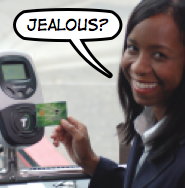
This issue is slowly rising in the community consciousness of the Bay Area, as people continue to hear news stories about the coming of Translink, and yet continue to endure delay after delay as BART stalls, obfuscates, delays, obstructs and otherwise does everything that they can to put off the actual opening day of Translink on their system as long as possible. This leads the educated populace of the Bay Area to ask important questions, like: BART, "Why are you still selling EZ Rider cards when Translink will take-over this process?"

Originally (around 2000-2001), MTC funded the roughly $99 million replacement of BART's aging original fare gates (which apparently were held together by duct tape and rubber bands) with new, modern fare gates with the understanding that the new faregates would be off-the-shelf compatible with the about-to-debut Translink electronic fare card. BART, however, had other ideas. They instead picked a faregate vendor (Cubic) that was in direct competition with MTC's Translink contractor (Motorola and their subcontractors). Though Cubic made claims that their system would be fully compatible with Translink, BART officials saw to it that they would have their own proprietary smart card system (EZ Rider) up and running and available to the general public years before they allowed Translink to come online.

There as some signs, however, that not only is BART finally on the verge of pulling their collective head out of their collective you-know-where and turning this system on; but that the region is on the verge of forcing some major changes on transit operators in the Bay Area. MTC suggests that "We need to undertake a fundamental reassessment of the region's transit system to identify ways to improve its productivity." This would include tackling the "tough questions," such as "overlapping services," "multiple services" that "complicate customer access," and "inconsistent service policies." Yes -- and we're all quite fed up with those "tough questions", we've had enough, and it's well past time to start looking for real solutions. Indeed, you know that somebody may have been pushed a bit too far, when even MTC begins to ask:
Can we continue to afford to support multiple operations, especially when the result is so complicated that it discourages ridership (e.g. Night Owl Service)?

Currently, after BART shuts down around midnight, the only way to leave San Francisco using transit (like, say, when the bars close at 2am) is by catching a bus that comes once an hour, and will take you to someplace where you will most likely need to transfer to another bus -- in the middle of the night -- to reach your final destination. Neither bus takes BART cards as fare payment. And, after closing down the bar and wandering out to take transit home -- how many people exactly have any money at all left in their wallet with which to pay transit fare? Did I mention that ticket machines for these buses do not exist at the bus stops where you catch them, and they don't take credit cards?

MTC continues to ask:
Can we continue to afford to accommodate inconsistent service policies when simple policy agreements are possible (e.g., discount fare eligibility)?

...and they go on to give an example of how none of the operators can agree on the percentage discount given to seniors and the disabled, the definition of "youth", the definition of "child," or how many children are allowed to ride free per paying adult rider.

MTC then presents an alternative, based on agreeing on common objectives as the starting point for a Regional Transit Sustainability Analysis:
Common Objectives

1.Identify changes in market demand
2.Develop cost-effective changes in
how service is delivered
3.Improve service reliability and
convenience to attract new riders
4.Create effective multi-year transition
to move riders into more productive
services

Regional Transit Sustainability Analysis

1. Analyze the transit system as a single network, ignore
jurisdictional lines.
2. Evaluate travel markets and best options for meeting demand.
3. Identify overlapping services -does the region supply too much
service in some corridors?
4. Identify cost-effective alternatives to unproductive services with
limited demand and higher subsidies.
5. Identify infrastructure improvements to reduce travel times and
increase service reliability on high volume routes.
6. Address duplication of basic customer service functions that can
be delivered more cost-effectively through consolidation.
7. Simplify fare policies and service information to encourage
transit use.

(I might add: Merge all of the Bay Area transit operators, fire all the top management, and consolidate all of the employee positions that don't actually involve driving or maintaining a bus, train, or ferry or their right-of-way, stations and associated facilities. Use the savings to help make transit operations more sustainable and focused on providing the best service on the most-heavily-traveled routes.)

Well, that brings us full circle. MTC is now suggesting that the transit operators simplify their fare policies to encourage transit use. Fully implementing Translink on all of the transit operators, beginning NOW with BART, would be a great first step along that path -- no study required, just flip the switch and enable people to get the cards!


*Correction: I originally stated that $338 million was the amount spent on Translink to date. This is incorrect. $338 million is the total amount budgeted for Translink over the life of the RTP to the year 2035/over the next 25 years.

Friday, March 06, 2009

There's a diesel Fiesta in Europe


...and you're not invited, American. You can't have it. It gets 65 mpg and does 0-60 in 12 seconds, which is plenty fast when you're getting 65 mpg (up to 73 mpg on the highway). It's called the Ford Fiesta ECOnetic, and it is an updated version for this year of the popular Ford Fiesta diesel that has been available in Europe for years. In fact, the existing European diesel Ford Fiesta is so popular, it has fan clubs (including a Croatian chapter). Can you imagine fan clubs for the Ford Fiesta in the United States? Please... but if we had the diesel model here (which has been an option in Europe and many other places around the world since 1983), you might see just that, especially among the biodiesel/veggie oil set!

But the Ford Fiesta is just the tip of the iceburg when it comes to the diesel party in Europe involving American-made-and-branded cars. The Chrysler corporation (formerly Daimler-Chrysler) offers a dozen Chrysler, Dodge and Jeep models for sale in Europe that feature diesel engines and -- get this -- achieve over 35 mpg on average! I mean, just think about that -- it's no secret that I think that Chryslers and Dodges are some of the worst vehicles on the road, with abysmal fuel economy and horrible maintenance histories. Yet, you slap a Mercedes diesel under the hood, and all of a sudden those vehicles don't look like such dogs any longer. Heck, a diesel Jeep sounds like a downright cool vehicle -- not as a daily driver, perhaps, but certainly for, you know, off-road excursions, snowy adventures, etc... especially a diesel Jeep with a Mercedes diesel under the hood! (Note: Some of the vehicles also feature the supremely efficient Volkswagen diesels.) From the U.S. perspective, it was certainly hard to see any effect that the partnership with Mercedes had on Chrysler during its duration -- but once you learn of these models, it all becomes clear. But, why can't we get those vehicles in the United States?

The automakers will claim that, due to California and EPA emissions requirements, they can't make a diesel clean enough to meet U.S. regulations. I call bullshit. I think there's something else going on -- they're afraid to sell such efficient vehicles here, because it might prove that they can actually make really efficient vehicles if they want to, and if Congress ever finds out, they might require the U.S. fleet to achieve vastly better fuel economy than 35 mpg by the year 2020... something that the U.S. auto industry is, strangely, opposed to.

I expect this to all change within the next couple of years, however. By 2011, I predict that we will begin to see a whole new array of high-mileage clean diesel vehicles that get much more than 35 mpg sold in the United States.

Heck, maybe one of them will even be a diesel-electric hybrid!

Saturday, February 21, 2009

Grow your own!!


So, we bought a house in north Oakland, CA (home of the Black Panthers!) this past December 2008... and ever since, have been working to turn the yard into a forest garden, an edible landscape of permaculture with a garden for annuals in the back. This just seems like good common sense to me, and a recent post on BlueOregon shows that the consciousness is spreading that we all need to be doing a little bit more of growing our own. Indeed, a recent article in AARP magazine shows that retired folks are finding that this is a great way to use some of that extra time they find on their hands, while reducing the burden of their food budget on their pocketbook!

So far, we've planted an orange tree, some rosemary, thyme, oregano and jasmine in the front yard (the last because it smells good and can serve as a centerpiece for the kitchen table). And in the back, the house came with a mature apricot tree, which we have surrounded with hops, blueberries, a faux-artichoke, a four-on-one apple tree, a fig tree, a currant bush, strawberries, lettuce and salad greens, carrots, peas, valerian, rhubarb ... and three chickens!! We'll be adding dozens of other crops over the next few months, as we haven't even started to plant our two raised beds, and also intend to add a few more fruit & nut trees & shrubs... I'm quite excited by it all, frankly!! I think it's one of the best parts of owning a house, that you can plant trees and stuff in the yard and know that they're your trees and shrubs and that you should be able to reap your own harvest, year after year (and if you move, well, the next occupant will be able to reap your harvest, year after year)!!

So go out there and plant edible stuff, anywhere and everywhere you can! Just pay attention to what each plant needs and wants (sun, partial sun, shade, good fertilized soil, poor well-drained soil) and give it to it at the beginning... it's just that simple!

cheers,
~Garlynn

Friday, February 20, 2009

Oregon's Trying to Go Idaho-Style


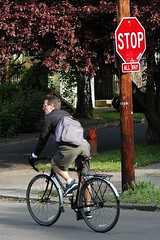
The Legislature of the State of Oregon is currently considering a bill that would make it legal for bicyclists to roll through stop signs (i.e., treat them as yield signs) when it is safe to do so. It would also allow cities to select certain specific intersections to sign/designate as areas where bicyclists would still be required to come to a full stop. It would NOT legalize proceeding through a stop light after coming to a complete stop.

Idaho has had a similar law on the books since 1982, with no reported adverse effects or incidents. They added a new provision allowing bicyclists to proceed through red stop lights (after first coming to a full stop) earlier this decade, reportedly because this option was cheaper than tuning the vehicle-detection-loops at every traffic light in the state such that they would detect bicycles.

While the Metropolitan Transportation Commission in the San Francisco Bay Area in California was studying this issue in 2008, that effort has apparently stalled.

Oregon may therefore yet become the first place outside of Idaho to legalize going "Idaho-Style."

Go Oregon!

cheers,
~Garlynn

Thursday, February 19, 2009

Lick It & Stick It


So, there's been a lot of political stuff going on lately, which has been dominating the coverage provided by this blog. But, since California passed a budget (covering the next 17 months or so) today, I figured I would switch gears and talk about something else.

Specifically... vinyl record players. This post, then, is for DJs and vinyl aficionados.

Sometime, when a DJ goes to play a record on a record player for the first time in a while, the record doesn't quite sound right. The needle is fine; the connections between the recond player and the amp are fine; the record itself is fine. What's the problem?

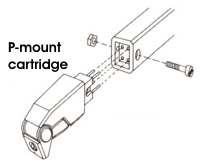
The problem is that, on Technics 1200s (and record players of a similar design), the physical connection between the needle stylus and the tone arm sometimes becomes not-so-great. A tiny gap will open up between the two sets of electrical contacts, and the electrical connection will be intermittent.

The solution?

Unscrew the needle stylus. Lick the electrical contacts (or, spit a little bit on your finger and rub it on the contacts). Then, screw the stylus back onto the tone arm.

This technique is known amongst DJs as "Lick It & Stick It."

It is also done with trepidation, because as any vinyl aficionado knows, Lick It & Stick It may fix the problem in the short term, but in the long term, it contributes to corrosion of the electrical terminals (the likely solution to which is further licking-it & sticking-it). It's therefore a self-propagating habit... the more a particular record player has experienced being licked & stuck in the past, the more it is likely to require this sort of treatment in the future.

Why does it work?

Basically, human saliva contains a certain amount of sodium, just like our blood (which, in fact, has nearly the same sodium level as that found on average in the world's oceans). Sodium in solution in a liquid conducts electricity -- it is known as "contact solution" (or an electrolyte) to folks working with electricity, because when applied sparingly at the point of contact between two electrical connections, it facilitates the flow of electrons from one side of the connection to the other.

Why should you not do it?

Human saliva also will cause those same contacts to corrode (oxidize or, basically, rust) over time.

What's the best solution?

According to Ortofon, you should clean the contacts with WD-40.

That's right -- another use for WD-40!!

And there you go -- the science behind Lick It & Stick It!!

cheers,
~Garlynn

Wednesday, February 18, 2009

FILIBUSTERS (open letter to Democratic Senators)


Dear Senator,

I would like an explanation for why Republicans in the United States Senate must only mention the threat of a filibuster to ensure that 60 votes are required for the passage of any bill. The filibuster was never meant as a device to ensure that every single bill required 60 votes for passage. Rather, it is a tool to be used by individual senators when they protest strongly to an individual bill and feel they have no other option to block its passage.

I REALLY would like to see the Democrats grow a collective backbone and call the bluff of the Republicans when it comes to filibusters. If they threaten to filibuster a bill, then they should be forced to get up and explain to the American public, for hours on end, why the bill is a bad idea. And, when they're done, the Democrats should just go ahead and pass the bill anyways.

This is, I feel, an extremely relevant point, as the ARRA bill was unnecessarily watered-down with tax cuts that only generate 0.95 jobs for every $1.00 of expenditure, just so taxpayers can get an extra $8 a week. We didn't elect you to give us $8 a week. We elected you to make the difficult decisions necessary to solve the big problems facing this country.

Calling the bluff of Republicans when it comes to filibusters in the United States Senate will need to become an essential strategy over the next couple of years. I would like an official response from my Senator as to why I haven't seen this strategy employed yet -- and, hopefully, a promise to employ it the very next time a Republican threatens a filibuster. CALL THEIR BLUFF.

Thanks.

Sunday, February 15, 2009

They Sure Showed That Obama (what they're really made of)


In yesterday's Times, Frank Rich gives us a (much-needed) positive spin on the stimulus package & its politics:

They Sure Showed That Obama

OK, so the stimulus package basically sucks. It also represents a political win for Obama, who can now check off the "attempted bipartisanship" box on his agenda, and move on to fixing the country with the rest of the items on his agenda (i.e. health care, etc.).

For transportation reform, which I care about deeply, this is also the year of transportation re-authorization, which is the really big battle. The stimulus may have not offered much of a down-payment on transportation, but that's OK -- re-authorization is where the real money and policy reform is at anyways.

There are a number of groups working on re-authorization, but the one that I'm hoping will be the most effective is Transportation For America (T4America), which is now headed up by my old buddy from MTC, James Corless. Check them out -- they're fighting the good fight.

And in the meantime -- across the country, from California to D.C., we're seeing what the Republican'ts are really made up, and how big it really us. I'm pretty sure that we're all watching, and learning. The question is, will the Democrats be able to pull us out of this giant mess single-handedly?

Saturday, January 24, 2009

OPEN LETTER ON THE STIMULUS PACKAGE


To the newly-elected administration and other leaders of this country-

You're preparing to pass a new stimulus package containing some $800 billion in new investment to help turn around the economy of this country.

That's great.

But, just as important, is that the Obama administration appears to be dropping the ball on making the right stimulus package moves. Their proposed investment in transportation, for instance (and as pointed out by Nobel laureate Paul Krugman), pales in comparison to the investment in tax cuts -- and studies show that tax cuts will do nothing to stimulate the economy, while investments in transportation will be nearly the most effective use of stimulus money.

Furthermore, we MUST insure that the transportation investments are targeted towards TRANSIT, BICYCLING, PEDESTRIANS, SMART GROWTH and MAINTENANCE and UPKEEP of existing roads.

The stimulus money should absolutely NOT be spent on building a whole new set of freeways that will allow for another century's worth of sprawl-inducement.

We don't need more roads and highways, we've spent the past 70 years building out that mode.

We need high speed rail.

We need bikeways.

We need sidewalks, paths and trails.

We need light rail, streetcars and more urban rapid transit.

We need high-speed freight.

We need to electrify our railroads so that they don't run on fossil fuels.

In short, we need a new transportation paradigm.

That's what we elected Obama to deliver -- and he appears to be backing down from his campaign promises to do so!!

Please help, we need you to help fix America.

Fixing our communities will also help fix health care... as people walk and bike more and drive less, they will become less obese. This will reduce the financial burden on the health care system. We cannot fix health care without also fixing our nation's infrastructure problem, and vice-versa. Everything is inter-connected.

But we must not invest in a new national health care system on the one hand, while with the other hand also investing in another 50-years worth of sprawl and sprawl-inducing highway infrastructure. Our national investments must be well-thought-out and coordinated.

Thank you.

Tuesday, October 28, 2008

Endorsements: CA Prop. 1A High Speed Rail. & more...


2008 is turning out to be a MASSIVE election. Since I have become old enough to vote, I can't think of another election where SO MUCH has been on the line, in SO MANY places. Here's a quick run-down of the MOST IMPORTANT THINGS.

United States President:

Barack Obama.

Do I need to explain this to anybody? He's the man.

CALIFORNIA:


Proposition 1A, High Speed Rail:

California truly can lead the nation if it passes Proposition 1a, by building a world-class high speed rail system to connect all of its major cities with one another. This in turn will probably jump-start a serious national discussion about high speed rail, as Congressional Representatives and Senators seek to bring home some high speed rail action to their own states when California brings up the topic of federal matching funds. Places in the world that already are boosting their economies with High Speed Rail (or planning to) include Mexico, Argentina, China, Taiwan -- oh yeah, and Japan and Western Europe. Not to mention jobs; 160,000 jobs will be directly created as a result of the project, and 450,000 jobs over the long term. That is more jobs than currently exist in the entire state of Alaska.

SONOMA & MARIN COUNTIES

Measure Q, SMART rail:


Sonoma and Marin counties have voted in the past on the issue of the Sonoma-Marin Area Rail Transit (SMART) project. It has always received greater than 50% of the vote, but never yet passed the 66.6% threshold required to raise the sales tax to fund construction of the project. Since the last time it was on the ballot, it has been tweaked to include night and weekend service proposals, as well as perfect the accompanying two-county-long bicycle trail. Several cities on the proposed alignment have already begun focusing their growth around the train stations (which in many cases already exist), including Cloverdale, Santa Rosa, Petaluma, Novato and San Rafael. This is the High Speed Rail project-equivalent for the North Bay (at least for Sonoma and Marin counties), and it is equally important for those areas. It will become the transportation centerpiece for these communities, tying them to one another and offering their residents the currently-unavailable option of NOT DRIVING to leave town. And, for those folks that would prefer to see, say, a dedicated-ROW Rapid Bus system: That is not the question on the ballot. This is the chosen technology, this is the proposal that currently has legs, and this is the project that will restore the livability of your communities.

OREGON

UNITED STATES SENATOR: JEFF MERKLEY

Oregon is currently home to the only remaining Republican United States Senator on the west coast of the lower 48 states, Senator Gordon Smith. He's worse than useless -- he's a rich playboy who owns a frozen-food packing plant, employing illegal aliens to pad his own pockets while doing nothing for federal immigration reform. This is an extremely tight race, so if you're an Oregonian, well, I probably don't need to tell you to be sure and send in your ballot and vote for MERKLEY FOR SENATE!

There are other endorsements I could make (California: Yes on 2, Yes on 5, No on 8), but those are really the MOST CRITICAL ISSUES.

Further, if you're an Oregonian, you already know... but if you're a Californian, I highly recommending registering as an absentee voter, or otherwise securing for yourself the right to vote by mail. I can't tell you how helpful it has been for me to go online and google things as I'm filling out my ballot. Especially for those issues where I had not yet made up my mind prior to seeing the ballot, this is so valuable that I really can't stress it enough.

OK, go out there and PARTICIPATE IN YOUR DEMOCRACY!!!

cheers,
~Garlynn

P.S. A disclaimer, and a special notice. After October 31st, 2008, I will no longer be with the Metropolitan Transportation Commission in Oakland, CA. I have accepted an offer to go join Peter Calthorpe & Associates in north Berkeley, CA as a Senior Planner in their regional planning division. One of my first projects there will be to work on a land use vision for California that is centered around the High Speed Rail project. So, while I will still have a job (and the vision project will continue forward) even if Proposition 1a fails, I would much prefer for my first project at Calthorpe to be relevant. So, tell everybody you know to vote Yes on Prop. 1a... they can do it for me, if for no better reason!!! :-)